Male or Female Joint? A Guide to 10mm, 14mm and 18mm Water Pipe Adapters
In short: most water pipe adapters for dry herb vaporizers have a male joint (frosted on the outside of the glass tube), and most water pipes and bubblers have a female joint (a socket frosted on the inside). So the real question is what size your socket is. Measure across the top of it: roughly 10 mm, roughly 14–14.5 mm or roughly 18–19 mm means a 10 mm, 14 mm or 18 mm joint. Then buy an adapter for your device with a matching male end, or a stepped 10/14/18 mm adapter that covers all three. If the sizes don't match, a simple glass converter can step up from 10 to 14 mm or from 14 to 18 mm.
This guide explains the male and female naming, how to measure without guessing, what converters can and cannot do, and which adapter each common vaporizer uses.
- Male and female joints in plain English
- 10 mm, 14 mm and 18 mm: what the numbers mean
- How to measure your water pipe
- When the sizes don't match
- Which adapter for which vaporizer
- Common mistakes
- FAQ
Male and Female Joints in Plain English
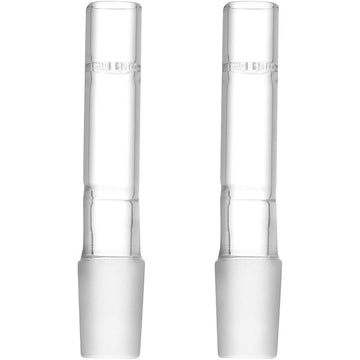
Glass joints come in pairs. The male side is a tube whose outside surface is ground (frosted) so it seals. The female side is a socket whose inside surface is ground. The male goes into the female, and the two frosted surfaces make the seal.
For vaporizers, the water pipe adapter (WPA) is nearly always male, because water pipes and bubblers are nearly always built with a female socket to take a bowl or downstem. So the usual question isn't "male or female?" but "what size is my socket?". You only need a female adapter in unusual setups, such as connecting to a water tool that has a male joint.
10 mm, 14 mm and 18 mm: What the Numbers Mean
These joints borrow their design from laboratory glassware, where tapered ground joints are standardised. The taper is 1 in 10, and the first number in a lab size (such as 14/20 or 19/22) is roughly the outside diameter at the widest point of the male joint. Water pipe sellers round those sizes to three names:
| Name you'll see | What to expect when you measure | Also sold as | Typical use |
|---|---|---|---|
| 10 mm | About 10 mm | – | Small bubblers, compact travel pieces, many DynaVap setups |
| 14 mm | About 14–14.5 mm | 14.5 mm | Most bubbler and mid-size water pipe listings |
| 18 mm | About 18–19 mm | 19 mm | Larger water pipes |
14 mm is the size you'll meet most often in the listings we checked. POTV says its bubblers use 14 mm connections. Arizer's comparison chart lists "14 mm & 19 mm" water pipe compatibility for its portables and includes a 14 mm adapter with several of them. Arizer's "19 mm" is the same joint other sellers call 18 mm. Even so, measure before you order.
How to Measure Your Water Pipe
- Take out the bowl so you can see the socket you'll actually connect to. If your pipe has a removable downstem, leave it in. Your adapter plugs into the downstem's socket, which can be smaller than the pipe's own joint.
- Look inside the opening. If there's a frosted band inside, it's female. If the frosting is on the outside of a tube, it's male.
- Measure straight across the inside of the opening with a ruler or callipers, at the widest point. Compare it with the table above.
- If you have the bowl that came with the pipe, measure the widest point of its frosted end instead. That gives you the same size.
- Still in between? Callipers settle it. A plain ruler is fine for telling 10 mm from 14 mm, but 14 mm and 18 mm look alike in photos.

When the Sizes Don't Match
Converters (sometimes called reducers or expanders) sit between your adapter and the water pipe. They only work in one direction, so check this table before you order:
| Your adapter's joint | Your water pipe's socket | What you need |
|---|---|---|
| 14 mm male | 14 mm female | Nothing; it plugs straight in |
| 10 mm male | 14 mm female | 10 mm female to 14 mm male converter |
| 14 mm male | 18 mm female | 14 mm female to 18 mm male converter |
| 14 mm male | 10 mm female | A 14 mm female to 10 mm male reducer, which we don't currently stock, or a 14 mm bubbler |
| Any male | A male joint | A female-to-female adapter, which we don't sell; ask us first |
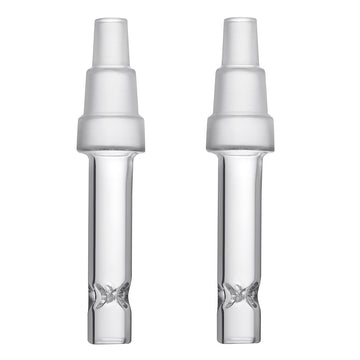
| Stepped 10/14/18 mm male | 10, 14 or 18 mm female | Nothing; push it in until the matching step seals |
Each converter adds height, which makes a tall setup more top-heavy, so hold the vaporizer while you draw. If you don't own a water pipe yet, the simplest route is to buy one that matches your adapter. Our multi-device bubbler has a 14 mm female joint for that reason: pair it with any 14 mm male adapter for your device.
Which Adapter for Which Vaporizer
The device end of an adapter is model-specific. The water end is where the 10/14/18 mm sizes come in. Here's how the devices we support connect:
| Device | Adapter | Water-end joint |
|---|---|---|
| Arizer Solo and Air series (not ArGo); stepped stem: Solo 3, Air 2 and Air MAX | 14 mm glass adapter stem, 70 mm, two-pack or stepped XL WPA stem | 14 mm male, or stepped 10/14/18 mm male |
| Arizer ArGo | ArGo 14 mm adapter or stepped ArGo WPA stem | 14 mm male, or stepped 10/14/18 mm male |
| POTV Lobo and ONE | 14 mm WPA stem or all-in-one 10/14/18 mm WPA | 14 mm male, or stepped 10/14/18 mm male |
| TinyMight 2 and 1 | Frosted male WPA | Stepped 10/14/18 mm male |
| DynaVap (metal-tip models) | All-in-one WPA | Stepped 10/14/18 mm |
| XMAX V3 Pro and V4 Pro | Stepped glass WPA (needs the black metal base, sold separately) | Stepped 10/14/18 mm male |
| LimeLight Frolic | Plug-and-play WPA | Fits 10/14/18 mm female joints |
| Storz & Bickel Mighty, Crafty and Venty | Device-specific side bubblers that push onto the cooling unit with a silicone gasket | No ground joint (see below) |
A note on the Mighty, Crafty and Venty
The Storz & Bickel portables don't have a ground glass joint of their own. Our Mighty and Crafty side bubbler and Venty side bubbler fit the cooling unit with a silicone gasket, so the 10/14/18 mm question doesn't come up. Third-party adapters that connect these devices to a full-size water pipe do exist, but their joint sizes vary by maker, and we couldn't find a standard size from Storz & Bickel. Check the listing for the specific adapter, or ask us before ordering.
Common Mistakes
- Ignoring angle and clearance. A matching joint size isn't the whole story. Check the vaporizer will sit at a usable angle and won't touch the pipe once it's connected.
- Buying by eye. 14 mm and 18 mm look similar in photos. Measure.
- Forcing a joint. Glass joints should slide together with a gentle twist. If one needs force, it's the wrong size.
- Letting the water pipe hold the vaporizer. Support the vaporizer and check the setup is stable before you draw.
- Overfilling. With a slitted downstem, water only needs to cover the slits by a little. For other designs, follow the pipe's own filling guidance. Add more and it can splash up into the adapter.
- Stacking converters. Each extra connector adds height and another joint that can move, so use as few as possible.
For cleaning everything afterwards, see how to clean water bubblers and glass attachments. Arizer owners can go deeper with choosing an Arizer WPA joint size.
FAQ
What is a water pipe adapter?
A water pipe adapter (WPA) is a glass piece that connects a vaporizer to a water pipe or bubbler. One end is shaped for the device, and the other has a standard male joint (10, 14 or 18 mm). Some devices use an all-in-one water attachment instead, such as a side bubbler, which needs no separate pipe.
Is 14 mm the same as 14.5 mm?
In practice, yes. Both names refer to the same joint, and its widest point measures about 14 to 14.5 mm.
Is 18 mm the same as 19 mm?
Usually, yes. Arizer, for example, calls the larger size 19 mm, while many water pipe sellers call it 18 mm.
Will a stepped 10/14/18 mm adapter fit every water pipe?
It fits female sockets in those three sizes. It won't fit a male joint, and very deep or very shallow sockets can feel less secure.
Do I measure the pipe opening or the downstem socket?
Measure the socket your adapter will actually plug into. If your pipe has a removable downstem, that's usually the downstem's socket, which can be smaller than the pipe's own joint.
Do I need a female adapter?
Rarely. Only if the piece you're connecting to has a male joint.